
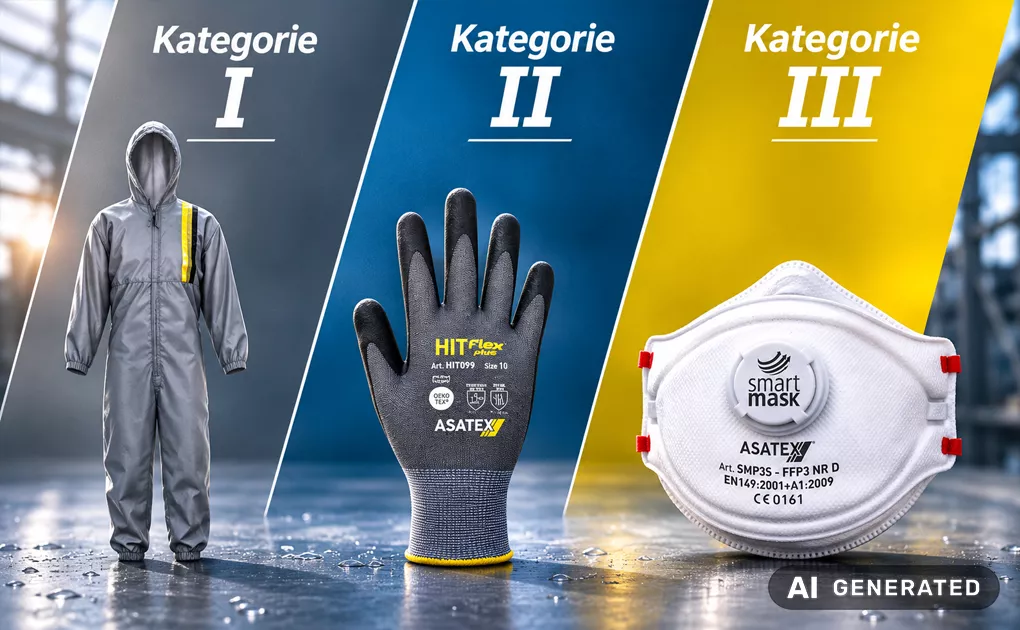
PPE categories I, II and III explained simply: What purchasing and occupational safety must check
A CE marking alone does not reveal how extensively a piece of personal protective equipment has been tested. Why do some products display a four-digit number after the CE marking? Why does a simple protective coverall require a different conformity assessment procedure than a chemical protective suit? And is Category III automatically better than Category II?
The answers lie in the PPE category.
Regulation (EU) 2016/425 classifies personal protective equipment into three categories. The decisive factor is not whether the product is a glove, a protective coverall, or a helmet. What matters is the level of risk the product is designed to protect against. This determines the required conformity assessment and surveillance procedure.
The risk determines the category. The category determines the conformity assessment procedure. The risk assessment determines the selection.
PPE Categories at a Glance
| Category | Risk Level | Assessment Procedure | ASATEX Example |
|---|---|---|---|
| Category I | exclusively minor risks | internal production control by the manufacturer | Polypropylene protective suit PP-1L |
| Category II | risks other than those listed in Category I and Category III | EU type-examination plus internal production control | CoverClean® Green CCG |
| Category III | risks that may cause very serious consequences such as death or irreversible damage | EU type-examination plus ongoing production monitoring | CoverFlash® CF5, Type 5B and 6B |
The three ASATEX protective suits illustrate that products within the same product group can belong to different PPE categories. The PP-1L is designated as Category I, the CCG as Category II, and the CF5 as Category III.
Why Risk, Not Product Type, Is the Decisive Factor
A protective glove is not automatically assigned to Category I, II, or III. The decisive factor is the protective function for which the specific product is intended.
A glove designed to protect against superficial mechanical injuries may belong to Category I. A work glove protecting against more severe mechanical risks is often assigned to Category II. Chemical protection gloves, on the other hand, generally belong to Category III, as hazardous substances can cause severe or irreversible damage to health.
The same applies to protective clothing. Two coveralls that look similar on the outside can be intended for completely different areas of application. Therefore, appearance, material thickness, or product designation do not allow for a reliable conclusion regarding the PPE category.
Category I: PPE Against Minor Risks
Category I includes exclusively minor risks, the effects of which users can identify in good time and assess themselves.
These include, for example:
- superficial mechanical injuries
- contact with weakly aggressive cleaning materials
- prolonged contact with water
- contact with warm surfaces not exceeding 50 °C
- atmospheric conditions that are not of an extreme nature
For Category I PPE, the manufacturer carries out the conformity assessment independently. This procedure is referred to as internal production control according to Module A. An external notified body is not required.
Nevertheless, the manufacturer must draw up the technical documentation, issue an EU declaration of conformity, provide user information, and affix the CE marking. Category I therefore does not mean "untested." However, the assessment takes place without a mandatory external type-examination.
Practical Example: Polypropylene Protective Suit PP-1L
The polypropylene protective suit PP-1L is designated as Category I PPE. It must not be equated with a certified chemical protective suit of Type 5 or Type 6.
Category II: PPE for All Other Risks
Category II is the so-called catch-all category. It includes risks that are neither explicitly assigned to Category I nor to Category III.
Typical examples include:
- many protective gloves against mechanical risks
- high-visibility clothing
- safety footwear
- industrial safety helmets
- certain eye and face protection
For Category II PPE, an EU type-examination according to Module B is mandatory. In this procedure, an independent, officially approved testing body examines a representative product sample and the corresponding technical documentation. The official EU term for this body is "notified body."
Following a successful examination, the notified body issues an EU type-examination certificate. Subsequently, the manufacturer ensures through internal production control according to Module C that the series-produced products continue to conform to the examined type. Categories II and III PPE are subject to a mandatory EU type-examination.
Practical Example: CoverClean® Green CCG
The CoverClean® Green CCG is certified as Category II PPE. This example illustrates that a protective suit can also belong to Category II, and that the category cannot be derived solely from the product group or its external appearance.
Category III: Protection Against Particularly Serious Risks
Category III includes risks that may cause death or irreversible damage to health.
These include, among others, hazards caused by:
- substances and mixtures which are hazardous to health
- harmful biological agents
- oxygen deficiency
- extreme heat or cold
- electric shock
- falls from a height
- harmful noise
Typical Category III products include respiratory protective equipment, chemical protective gloves, chemical protective suits, hearing protection, and personal fall protection equipment.
Which Assessment Procedures Apply to Category III?
Category III PPE also requires an EU type-examination. In addition, ongoing production is monitored by an independent notified body. For this purpose, the PPE Regulation provides for two possible procedures:
- Module C2: supervised product checks at random intervals
- Module D: quality assurance of the production process
For Category III PPE, the CE marking is therefore followed by a four-digit identification number. It identifies the notified body involved in the ongoing production monitoring. The number is neither a product standard nor a quality rating.
Practical Example: CoverFlash® CF5
The CoverFlash® CF5 is designated as Category III PPE as well as Type 5B and 6B. Among other things, it offers protection against solid airborne particles, limited liquid splashes, and infective agents.
Assessment Procedures Briefly Explained
| Module | Meaning |
|---|---|
| A | internal production control by the manufacturer |
| B | EU type-examination by an independent notified body |
| C | internal control of series production by the manufacturer |
| C2 | supervised product checks at random intervals from series production |
| D | quality assurance of the production process |
The EU type-examination certificate and the EU declaration of conformity are not the same thing. The type-examination certificate is issued by the notified body and confirms the assessment of a representative product sample. By issuing the EU declaration of conformity, the manufacturer declares under their own responsibility that the product actually placed on the market complies with the applicable requirements.
What Do the Categories Mean for Protective Suits?
An overall is not automatically personal protective equipment. Simple workwear without a designated protective function does not fall under the PPE Regulation purely based on its design. However, if a protective suit is intended to protect against contamination or other hazards, it qualifies as PPE.
Protection Types of Chemical Protective Suits
When sourcing chemical protective suits, buyers frequently encounter the following designations:
- Type 3: liquid-tight
- Type 4: spray-tight
- Type 5: particle-tight
- Type 6: limited protection against liquid splashes
Important: The protection type is not the PPE category.
The protection type describes tested protective performance. The PPE category, on the other hand, describes the severity of the risk and determines the required assessment procedure. A protective suit can therefore belong to Category III while simultaneously meeting the requirements for Type 5 and Type 6, for example.
Differentiating Between PPE Category, Product Standard, Protection Type, and Performance Level
Product standards, protection types, and performance levels also each fulfill a distinct function:
| Term | Meaning |
|---|---|
| PPE Category | describes the severity of the risk and determines the required assessment procedure |
| Product Standard | defines testing methods and requirements for a specific protective function |
| Protection Type | describes a defined protective performance of a protective suit |
| Performance Level | indicates the result of a specific test |
What Should Procurement and Health & Safety Teams Check?
Prior to procurement, attention should not be focused solely on the CE marking. The decisive factor is whether the product, its associated documentation, and the intended application align with one another.
A compact check includes the following points:
- Does the protective function match the risk assessment?
- Is the PPE category clear and plausible?
- Is the CE marking complete?
- For Category III, is the four-digit identification number placed after the CE marking?
- Is a clearly traceable EU declaration of conformity available?
- For Category II and Category III, is the EU type-examination verifiable?
- Do the product designation and the documentation match?
- Do the standards, protection types, and performance levels suit the intended use?
- Are clear user instructions provided in the required national language?
- Is the PPE compatible with other protective equipment being used?
Formally compliant PPE is not automatically suitable for every task. Only the workplace risk assessment determines which protective function and performance level are required for the specific job.
FAQ: Frequently Asked Questions About PPE Categories
Does Only Category III Require a Type-Examination?
No. Both Category II PPE and Category III PPE require an EU type-examination according to Module B. For Category III, ongoing production monitoring according to Module C2 or Module D is additionally required.
Are Protective Suits Always Category III?
No. Depending on its intended protective function, a protective suit can belong to Category I, II, or III. Furthermore, simple workwear without a designated protective function may fall outside the scope of the PPE Regulation.
Must the Type-Examination Certificate Accompany Every Product?
No. However, for Category II and III PPE, it should be verifiable that a valid EU type-examination exists. The EU type-examination certificate can additionally be requested during audits or tender processes.
What Does the Number After the CE Marking Mean?
For Category III PPE, the four-digit identification number identifies the independent notified body involved in ongoing production monitoring. It is neither a product standard nor an indication of protective performance.
Conclusion: Risk First, Then the Category
PPE categories indicate the severity of a risk and specify the required assessment procedure for the product. They are not quality levels and do not replace the workplace risk assessment.
The three ASATEX examples PP-1L, CCG, and CF5 illustrate how differently protective suits can be classified. Although all three products belong to the coverall category, they fulfill different protective functions and are therefore assigned to Categories I, II, and III.
The risk determines the category. The category determines the assessment procedure. The risk assessment determines which PPE is actually suitable.