
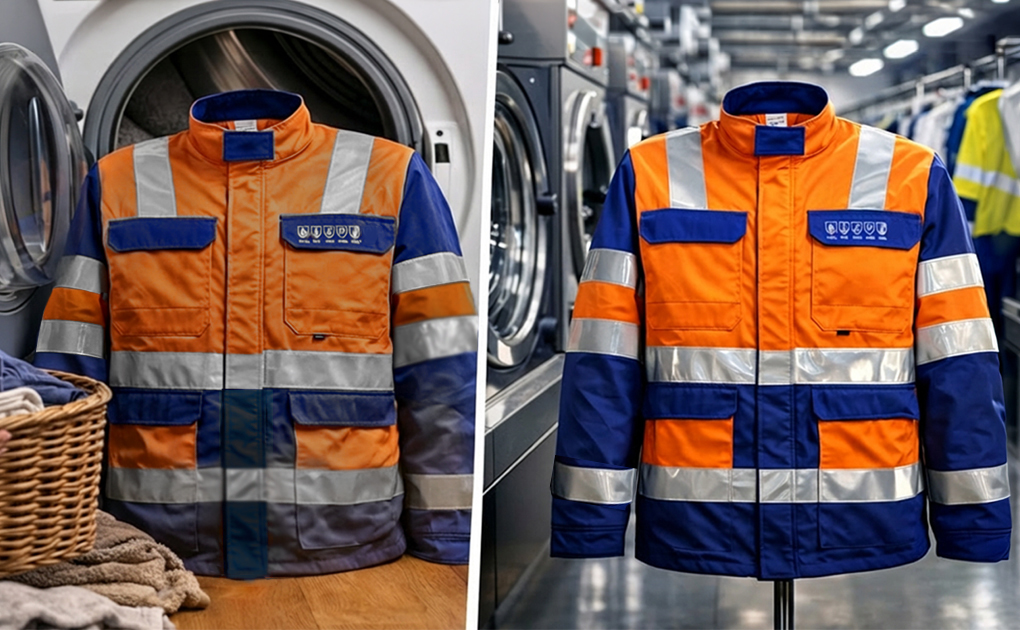
Risks associated with washing PPE at home
Washing PPE: Why ‘household laundry’ does not belong in your washing machine at home
Your high-visibility jacket is dirty after your shift, your multi-standard dungarees have oil stains on them – so you want to take them home quickly and put them in your own washing machine?
This is exactly what happens in practice – and this is precisely what makes personal protective equipment (PPE) so high-risk.
This article is aimed at PPE retailers, safety specialists and purchasing managers. It shows:
• What the wash tub symbol on PPE labels really means
• Why PPE should not be washed privately
• What role professional laundries play
• And what questions customers ask most frequently about PPE cleaning.
What ‘domestic laundry’ really means in PPE
The wash tub on the care label symbolises the household washing process (hand or machine wash). This is often equated with the term ‘household laundry’ and misunderstood.
Technically, it refers to washing and drying processes with household-like parameters, as described, for example, in the EN ISO 6330 standard. This standard specifies the temperatures, drum movements, water levels and drying processes used to wash textiles in the test laboratory.
That means:
• The material is generally designed for washing under domestic conditions.
• This does not mean that employees should wash PPE privately at home.
• It does not say anything about whether protective functions are retained with ‘any’ programmes, detergents and loads.
"Important communication for PPE retailers:
“Domestic laundry” refers to the tested procedure, not approval for use in domestic washing machines."
Why PPE should not be washed at home
1. Normal detergents attack protective functions
Household detergents are optimised for everyday clothing. They contain, among other things:
• Surfactants
• Bleaching agents
• Optical brighteners
• Enzymes
In the case of PPE, this can have serious consequences:
• High-visibility protection: Reflective strips gradually lose their reflectivity, fluorescent outer fabrics fade more quickly – visibility and compliance with standards may be compromised.
• Flame and heat protection: Incorrect detergents or excessive dosages can weaken flame-retardant finishes, as well as antistatic finishes.
• Chemical protection (EN 13034, Type 6/6B):
The protective effect of limited chemical protection is based, among other things, on the liquid-repellent properties of the outer material. These ensure that splashes do not immediately penetrate the fabric, but initially roll off. Household detergents, incorrect dosages or repeated unsuitable washing processes can gradually break down this impregnation. The result: liquids wet the material more quickly – the tested repellent properties may be reduced without this being visually apparent."
Technical information on occupational safety and PPE cleaning consistently emphasises that protective clothing that has been washed incorrectly can lose its tested protective performance – often without this being apparent from the appearance of the fabric.
2. Fabric softeners and residues increase flammability
Fabric softener makes laundry soft because it leaves a film on the fibres. For PPE, it is precisely this film that is the problem:
• It may adversely affect the fire behaviour of flame-retardant, welding and arc flash protective clothing.
• The conductivity of antistatic clothing may be negatively affected.If oil or grease residues remain in the fibres, the clothing may, in the worst case, become significantly more flammable.
• If oil or grease residues remain in the fibres, the clothing may, in the worst case, become significantly more flammable.
In short: what feels comfortable for the wearer can become an additional risk in an emergency.
3. ‘Clean’ does not necessarily mean ‘safe’
It is not visible to the naked eye,
• whether hazardous substances, oils, greases or chemicals have been completely removed,
• how much the warning colours and reflective properties have already deteriorated,
• whether flame-retardant or antistatic equipment still complies with the required standard values.
The result:
The clothing looks clean, but from an occupational safety perspective, it no longer provides reliable protection.
Why PPE belongs in specialist shops
The crucial point for PPE distributors and employers:
It is not a question of whether PPE can be washed with water (technically speaking: usually yes), but who does so under controlled conditions.
Professional laundries and dry cleaners specialising in workwear and protective clothing work with:
• Specially formulated detergents and dosing systems,
• Fixed programmes without fabric softener,
• Defined temperatures and mechanics,
• Clear specifications for the maximum number of wash cycles,
• Process control and documentation.
At the same time, environmental issues are also addressed:
Hazardous substances, oils, greases or particles from PPE do not end up unfiltered in domestic wastewater, but are collected via filter and separation systems and disposed of properly.
This is an important argument for PPE retailers:
specialist clothing is not just “nice to have”, but part of the protection concept.
Legal framework: employers remain responsible
The PPE Usage Regulation (PSA-BV) and information from the BAuA clearly state:
• The employer must ensure that PPE functions properly and is hygienically sound throughout its entire period of use.
• The protective performance of PPE must be maintained even after cleaning and maintenance – these measures may only be carried out in accordance with the manufacturer's instructions.
This also makes it clear from a legal perspective:
Taking PPE home and having it washed privately is not in line with technical requirements or responsibilities.
As a PPE retailer, you can actively address this issue and point out the combination of product + professional care to your customers.
Care symbols for PPE: What customers should know
Care symbols are not decorative elements, but part of the safety information. The following are particularly relevant for PPE:
• Washing tub
- Number = maximum temperature (e.g. 40 °C).
- Line(s) below = gentle or special wash cycle.
• Triangle
- Empty = bleaching generally possible (rare for PPE),
- Crossed out = do not bleach.
• Square with circle
- Dots = permissible tumble dryer temperature,
- Crossed out = do not tumble dry.
• Iron
- Dots = ironing temperature,
- crossed out = do not iron.
• Circle (cleaning symbol)
- Letter in circle (e.g. P or F) = approved solvents for professional cleaning,
- crossed out = no dry cleaning permitted.
Important for your consultation:
The symbols indicate the maximum permissible limits. The manufacturer's instructions specify how cleaning should be carried out safely – and ideally, a contract with a laundry that is familiar with PPE.
Conclusion for PPE retailers and companies
For your customers, you can sum it up in one sentence:
‘Domestic washing process’ describes a test procedure – not a free pass for your washing machine at home.
• Protective clothing is designed for specific washing processes, not for spontaneous 40-degree coloured washes with fabric softener.
• Incorrect detergents, fabric softeners and residual dirt can invisibly damage PPE.
• The responsibility for functional, hygienic PPE lies with the employer – and therefore with professionally organised cleaning processes.
Anyone selling PPE should always sell cleaning as part of the package: as a safety argument, as a service and as a way of distinguishing themselves from purely ‘cheap textiles’.
FAQ: Frequently asked questions about ‘washing PPE’
1. Can I wash PPE in a normal washing machine?
Many PPE items are technically designed for household-type washing processes. In practice, however, private washing machines are problematic: detergents, programmes, loads and separation of contamination are difficult to control. For standard-compliant protection, cleaning by a specialist company is the safe solution.
2. Can I wash work clothes and PPE together with normal laundry?
No. Protective clothing should always be washed separately from private clothing. This is partly due to possible contamination (oils, fats, hazardous substances) and partly due to the special requirements for detergents and programmes.
3. What is the optimal temperature for washing PPE?
The permissible temperature is indicated in the washing symbol and in the manufacturer's information. Often, 40 °C or 60 °C are specified – but always in combination with suitable detergents and defined processes. Temperature alone does not determine cleanliness or protection.
4. Why is fabric softener prohibited in PPE?
Fabric softener leaves a film on the fabric. This film can have a negative effect on flame-retardant properties, antistatic treatment and fire behaviour. In combination with oils and fats, clothing can become more flammable – therefore: do not use fabric softener on PPE.
5. Who must pay for the cleaning of PPE – employees or employers?
Legally, the employer is responsible for ensuring that PPE is functional and hygienically sound. It follows that the organisation and costs of professional cleaning are the responsibility of the company, not the employees.