
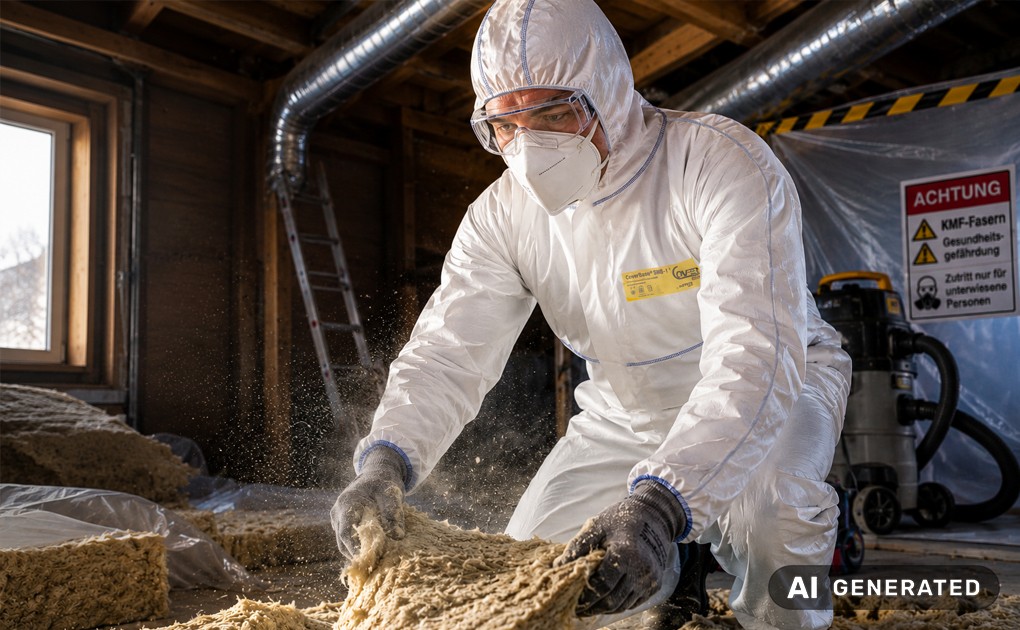
New TRGS 521 published: Stricter requirements for activities involving old mineral wool
With the publication of the amended Technical Regulation for Hazardous Substances (TRGS) 521, ‘Work involving old mineral wool’, on 4 May 2026, new requirements for the handling of man-made mineral fibres (MMFs) will come into force. The revised regulation replaces the previous version from 2008 and significantly broadens its scope.
The scope is no longer limited to traditional demolition, refurbishment and maintenance work. Decommissioning, selective dismantling, technical insulation work and activities in existing buildings are now covered more comprehensively. At the same time, the requirements for risk assessment, documentation, occupational health precautions and personal protective equipment (PPE) are increasing.
This raises the question for companies: what protective measures and what protective clothing are now required when working with old mineral wool?
What is mineral wool?
Mineral wool is a generic term for synthetically produced inorganic insulation materials made from mineral raw materials such as rock, sand, lime or recycled glass. For decades, it has been one of the most important insulation materials in building construction, building services engineering and industrial plant construction.
A basic distinction is made between two main types:
- Glass wool – produced mainly from waste glass, sand and lime.
- Rock wool – produced from rocks such as basalt or diabase.
Both materials consist of fine mineral fibres that are processed into mats, boards, shells or loose-fill insulation. They offer high thermal and acoustic insulation and are widely used due to their non-combustibility.
What does KMF stand for?
KMF stands for man-made mineral fibres. These include, amongst others, glass wool and rock wool. In the context of TRGS 521, the focus is particularly on older KMF products which, according to current scientific knowledge, may be classified as potentially carcinogenic.
What is meant by ‘old mineral wool’?
Not all mineral wool is subject to the same occupational health and safety requirements. TRGS 521 focuses on so-called old man-made mineral fibres that were manufactured and installed before 1996.
These older insulation materials do not meet today’s requirements regarding the biodegradability of the fibres. If such fibres enter the lungs, they are broken down by the body only slowly, if at all. For this reason, many of these products have subsequently been classified as potentially carcinogenic.
Modern mineral wool that complies with current European requirements is not classified as carcinogenic provided that the European clearance criteria (Note Q) are met.
Comparison of Old and New Mineral Wool
| Feature | Old Mineral Wool | Modern Mineral Wool |
|---|---|---|
| Typical installation period | Often before 1996 | Since the introduction of biosoluble fibres |
| Fibre biopersistence | Low | High |
| Classification | Potentially carcinogenic | Generally not classified as carcinogenic when the exemption criteria are met |
| Relevance for TRGS 521 | High | Generally not covered by the scope of application |
Where is old mineral wool found?
Old mineral wool can still be found today in numerous buildings and technical installations. It is particularly common in the following areas:
- Roof and façade insulation
- False ceilings and partition walls
- Pipe insulation
- Heating, ventilation and air-conditioning systems
- Industrial insulation
- Fire protection structures
Particularly in the case of buildings or installations constructed or modernised before 1996, checks should be carried out to determine whether such insulation materials are present before any demolition or refurbishment work begins.
Why is old mineral wool problematic?
As long as older mineral wool remains undamaged in its installed state, it generally poses only a low risk. However, the situation becomes critical during demolition, removal or refurbishment work. During such work, fine fibres may be released, which can be inhaled or irritate the skin and eyes.
Possible effects include:
- mechanical irritation of the skin and eyes
- irritation of the upper respiratory tract
- inhalation of respirable fibres
- spread of fibres via clothing and tools
For this reason, work involving old mineral wool is subject to specific requirements under the Hazardous Substances Ordinance and TRGS 521.
What does the new TRGS 521 cover?
The amended TRGS 521 broadens the previous focus on traditional demolition, refurbishment and maintenance work. In future, it will apply generally to all activities involving old mineral wool.
These include, amongst others:
- Demolition work
- Selective dismantling work
- Removal work
- Work in existing buildings
- Technical insulation work
- Remediation of hazardous substances
- Cleaning work in contaminated areas
An overview of the key changes
- Extended scope of application to cover all activities involving old mineral wool
- More precise classification into exposure categories
- Stricter requirements for extraction and dust control technology
- New documentation and record-keeping obligations
- Extended occupational health and safety precautions
- Additional information obligations for clients and project initiators
Exposure categories: Why correct classification is crucial
The new TRGS 521 contains specific guidelines for classifying activities into different exposure categories. Corresponding classification tables are available for typical work in building construction and on technical insulation.
If activities are not listed there, either the protective measures for the highest exposure category must be applied, or the effectiveness of the chosen protective measures must be verified through workplace measurements.
Demolition and dismantling work, in particular, often falls under at least exposure category 2 and requires appropriate documentation and precautionary measures.
What requirements does TRGS 521 set for protective clothing?
Personal protective equipment (PPE) is an important component of the protection concept. It complements technical measures such as extraction and appropriate air flow, and helps to minimise contact with released mineral fibres and their spread.
A practical PPE concept includes, in particular:
- a Type 5 particle-tight protective suit, depending on the exposure category
- at least FFP2 respiratory protection in accordance with the risk assessment
- protective gloves
- safety goggles for dust-intensive activities
- suitable foot protection or shoe covers
For activities in exposure category 2 involving concentration peaks, as well as for activities in exposure category 3, TRGS 521 requires the use of Type 5 particle-tight protective suits.
To meet this minimum requirement, protective suits made from SMS materials, for example, can be used. However, depending on the risk assessment, protective suits made from laminated materials or flash-spun polyethylene may also be a suitable choice. Their smoother material surface can help to reduce the adhesion of mineral fibres and thus the risk of subsequent secondary inhalation when removing the protective clothing.
Disposable protective suits protect the workwear worn underneath, reduce direct contact between the fibres and the skin, and help to prevent contamination from being carried into uncontaminated areas. Once the work is complete, they can be removed in a controlled manner and disposed of in accordance with company guidelines.
The ASATEX range includes, for example, the CS500E, CS500 and CF5 protective suits, depending on the area of application. When making a selection, freedom of movement, comfort and the specific working conditions should be taken into account alongside the required level of protection.
Technical protective measures remain the most important foundation
The new TRGS 521 makes it clear that personal protective equipment is only one component of a comprehensive protection strategy.
The following are of particular importance:
- low-dust working methods
- suitable industrial vacuum cleaners and construction dust extractors
- high-performance extraction and filter systems
- controlled air flow
- regular cleaning of work areas
- training for employees
Only the combination of technical, organisational and personal protective measures ensures effective protection against fibre exposure.
New documentation and precautionary obligations
With the amended TRGS 521, the requirements for documentation and record-keeping have also increased. For activities classified as exposure category 2 or higher, employees must be included in the exposure register in accordance with Section 10a of the Hazardous Substances Ordinance.
Furthermore, occupational health check-ups are becoming increasingly important. Depending on the relevant exposure category, employers must assess whether voluntary or mandatory check-ups are required.
Companies should therefore review their existing risk assessments, training programmes and documentation processes as soon as possible and adapt them to the new requirements.
Checklist: What companies should check now
- Update the risk assessment
- Assess the presence of old mineral wool
- Check the exposure category of the activities
- Check extraction and dust control systems
- Assess the PPE policy and protective clothing
- Introduce or update the exposure register
- Organise occupational health checks
- Provide regular training for employees
FAQ – Frequently asked questions about the new TRGS 521
What is TRGS 521?
TRGS 521 regulates the safe handling of old mineral wool and sets out protective measures for work involving man-made mineral fibres.
What is KMF?
KMF stands for man-made mineral fibres. These include, in particular, glass wool and rock wool, which are used as insulation materials in the construction industry and in technical installations.
Which mineral wool is affected?
Mineral wool installed before 1 June 2000 may contain man-made mineral fibres which, according to current criteria, are considered to be potentially carcinogenic. In practice, the year of construction prior to 1996 is often used as an initial guide, as biosoluble mineral wool has been increasingly used since the mid-1990s. However, the decisive factor is always the product actually installed.
Is mineral wool asbestos?
No. Mineral wool and asbestos are different materials. Whilst asbestos is a naturally occurring mineral, glass wool and rock wool are manufactured. However, special health and safety regulations also apply to older types of mineral wool.
What PPE is recommended when working with old mineral wool?
Depending on the risk assessment, this includes a particle-tight protective suit, respiratory protection, protective gloves, safety goggles and suitable footwear. For certain activities, TRGS 521 requires a Type 5 protective suit and at least FFP2 respiratory protection.
Why are disposable protective suits useful?
They reduce direct contact with mineral fibres, protect the workwear worn underneath and help to prevent fibres from being carried into uncontaminated areas.
What has changed as a result of the new TRGS 521?
The revised version broadens the scope, specifies the exposure categories in greater detail, increases the requirements for technical control measures and extends the documentation and precautionary obligations.
Is modern mineral wool harmful to health?
Modern mineral wool generally meets the requirements for the biosolubility of the fibres and, provided the European classification criteria are met, is not classified as carcinogenic. Nevertheless, even modern mineral fibres can cause mechanical irritation to the skin, eyes and respiratory tract. However, their health assessment differs significantly from that of older mineral wool.
How is old mineral wool disposed of?
Old mineral wool must be collected, packed and disposed of in a dust-tight manner in accordance with the applicable waste management and health and safety regulations. The necessary protective measures and suitable personal protective equipment must be used when doing so.
Conclusion: The new TRGS 521 raises the standards for occupational safety
The amended TRGS 521 makes it clear that work involving old mineral wool requires careful planning and a comprehensive safety strategy. In addition to technical and organisational measures, the selection of suitable personal protective equipment plays a key role.
Particularly during demolition, dismantling and refurbishment work, suitable disposable protective suits, respiratory protection and the controlled removal and disposal of contaminated PPE help to effectively protect workers from fibre exposure and the spread of mineral fibres.
ASATEX supports companies in selecting suitable protective clothing for work involving man-made mineral fibres and dust-intensive refurbishment work. Our PPE experts provide practical advice on protection strategies, standards and suitable solutions for your specific area of application.