
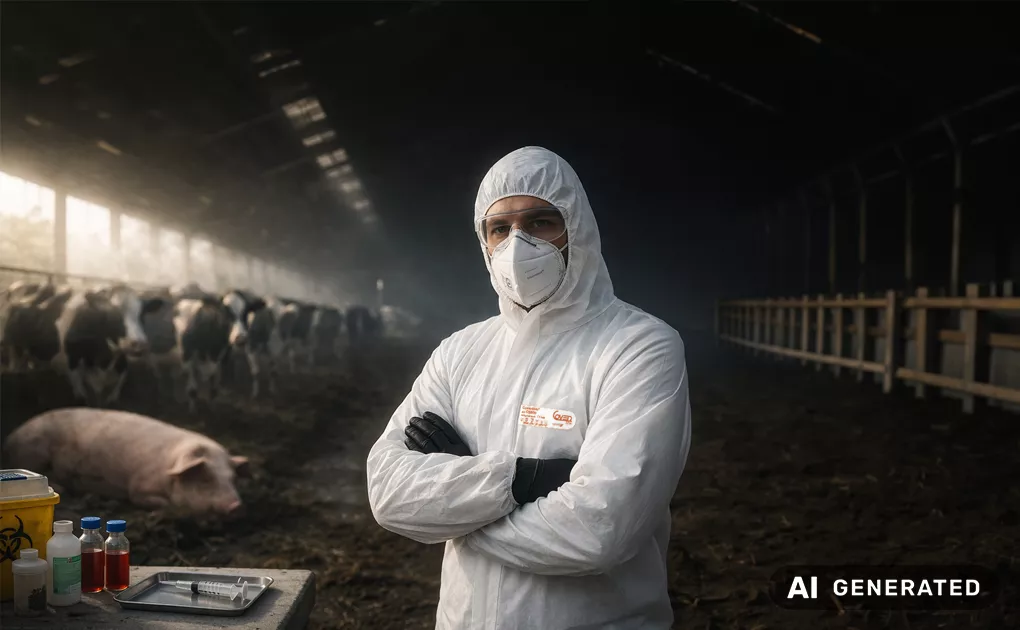
PPE in agriculture: Which protective clothing in the barn really makes sense
A livestock barn is not a neutral workplace. It is not only about dirt, moisture, and physically demanding work. It is also about animal health, biosecurity, and work processes where even small mistakes can quickly have serious consequences.
Particularly in livestock farming, it is not enough to simply put on any protective coverall. Anyone entering animal housing areas, inspecting livestock, collecting samples, or carrying out cleaning tasks is working in a sensitive environment. Dust, moisture, microorganisms, organic residues, as well as cleaning and disinfecting agents are all part of everyday work.
For this reason, personal protective equipment (PPE) is not just practical workwear, but an essential component of an effective hygiene and biosecurity concept.
Why Biosecurity Is So Important in Agriculture
Biosecurity does not begin only when a farm is directly affected by a disease outbreak. It starts with everyday operations: entering sensitive livestock areas, moving between different biosecurity zones, carrying out animal inspections, and performing hygiene and cleaning procedures.
Animal diseases such as African swine fever, avian influenza, and foot-and-mouth disease demonstrate how important it is to prevent pathogens from being introduced onto a farm or spread within the operation. In addition, farms face hygiene challenges, bacterial contamination, and the transfer of germs between sensitive areas. Not every risk is immediately visible, making clearly defined procedures and appropriate protective measures all the more essential.
Personal protective equipment (PPE) cannot replace a comprehensive biosecurity program. However, it is an essential component whenever employees, visitors, or service providers enter areas where strict hygiene and biosecurity measures must be consistently maintained.
Risks in Everyday Barn Work That Are Often Underestimated
In agriculture, hazards rarely occur in isolation. In most cases, several risk factors are present at the same time:
- Dust and airborne particles in barns and storage areas
- Moisture and dirt on surfaces
- Contact with organic materials
- Splashes during cleaning and disinfection work
- Skin exposure caused by wet work and cleaning agents
- Mechanical stress during handling, lifting, carrying, and cleaning tasks
It is precisely this combination of hazards that makes the difference. In day-to-day work, employees are rarely exposed to just a single risk. Anyone working in a livestock barn therefore needs more than a one-size-fits-all solution—they need personal protective equipment (PPE) that is matched to the specific task and the associated risks.
Where PPE Is Specifically Needed in Agriculture
In agriculture, personal protective equipment (PPE) plays a particularly important role wherever hygiene, biosecurity, and clearly defined work procedures come together. Typical areas of application include:
- Entering sensitive livestock housing areas
- Animal inspections and veterinary-related tasks
- Sample collection and hygiene inspections
- Cleaning and disinfection work
- Quarantine and biosecurity containment areas
- Tasks involving dust, dirt, or light splash exposure
- Transitions between outdoor areas and hygiene-sensitive zones
It is at these critical transition points that the effectiveness of a farm's protective and hygiene concept is put to the test in everyday operations.
Why a Protective Coverall Alone Is Not Enough
A protective coverall is often a key component of personal protective equipment (PPE). However, it does not automatically protect against every hazard. Depending on the task, appropriate protective gloves, respiratory protection, eye or face protection, and suitable footwear are also essential parts of an effective protection strategy.
This is exactly where gaps often occur in practice. The protective coverall may be the right choice, but the gloves may not provide the required level of protection. The protective clothing may be suitable, yet respiratory or eye protection is missing during dusty tasks or work involving splash hazards. Effective PPE therefore does not consist of individual items alone—it is a carefully coordinated combination of protective equipment designed to address the specific risks of each task.
What Protective Clothing Is Suitable for Agriculture?
Protective clothing used in agriculture must provide reliable protection while also being practical for everyday work. A protective coverall may meet all technical requirements on paper, but if it is perceived as too hot, too stiff, or uncomfortable, it is far less likely to be used consistently in daily operations.
The following characteristics are particularly important:
Durability
Protective clothing must withstand the demands of everyday agricultural work. Constant movement, abrasion, and frequent donning and doffing are all part of routine work in livestock facilities.
Freedom of Movement
Anyone caring for animals, carrying out inspections, bending, or performing cleaning tasks needs protective clothing that allows unrestricted movement without compromising protection.
Comfort
For extended periods of use, factors such as weight, breathability, and proper fit play a crucial role in ensuring comfort and encouraging consistent wear.
Hygiene Compatibility
In hygiene-sensitive areas, protective clothing should be selected to fit the farm's biosecurity and hygiene protocols and should allow for safe and proper donning and doffing procedures.
Protective Coveralls in Agriculture: Not Every Coverall Is Suitable for Every Task
For agricultural operations, there is no single protective coverall that is suitable for every application. The key is to select the right coverall based on the specific task and the hazards involved.
For Demanding Cleaning and Disinfection Tasks
Work involving increased splash exposure or more intensive contact with cleaning and disinfecting agents requires higher-performance protective solutions. In these situations, the CoverStar® Plus CS400 can be an appropriate choice.
For Barn Hygiene, Animal Inspections, and Biosecurity-Sensitive Areas
Routine hygiene procedures, animal inspections, hygiene stations, and other biosecurity-sensitive areas require durable, versatile protective clothing. The CoverStar® CS500 combines reliable protection with the comfort needed for everyday use.
For General Hygiene Tasks
If a cost-effective standard solution is required for general hygiene work, the CoverStar® Eco CS500E is a suitable option.
For Extended Tasks Requiring Greater Freedom of Movement
When mobility and wearing comfort are the primary priorities, the CoverFlash® CF5 offers distinct advantages. Its lightweight, breathable material makes it particularly well suited for extended periods of use where protective clothing must remain both practical and comfortable.
Protective Gloves in Agriculture: Often Overlooked, Yet Essential
When it comes to personal protective equipment (PPE), protective coveralls are often the primary focus. However, hands are among the most heavily used parts of the body in agricultural work and are exposed to a wide range of hazards every day.
They come into contact with moisture, dirt, rough surfaces, cleaning and disinfecting agents, as well as organic residues. At the same time, workers need to maintain a secure grip while carrying, cleaning, and handling tools. For this reason, there is no single glove that is suitable for every task.
Which Protective Gloves Are Suitable for Agriculture?
For cleaning and disinfection tasks, chemical-resistant gloves may be required. The appropriate glove depends primarily on the cleaning or disinfecting agent being used, its concentration, the duration of exposure, and the manufacturer's recommendations. Depending on the application, suitable options include the models 3490, 3450, 3450-ECO, 3452, or 3470.
For general livestock and barn work, where a secure grip, mechanical durability, and resistance to oils and grease are important, robust nitrile work gloves are a good choice. Suitable examples include the models 3420 and 03400LP.
The key is not simply wearing gloves—it is choosing gloves that are appropriate for the specific task, the substances being handled, and the hazards involved.
Considering Respiratory and Eye Protection
For dust-intensive activities or tasks involving splash hazards, protective clothing alone is often not sufficient. When airborne particles, aerosols, or chemical hazards are present, suitable respiratory protection as well as eye or face protection must be included in the protection concept from the outset.
Many protection gaps do not occur because personal protective equipment (PPE) is completely unavailable. Instead, they often arise when individual components are missing or when the different elements are not properly coordinated with each other.
What Businesses Should Consider When Selecting PPE
The selection of suitable personal protective equipment (PPE) does not begin with a product catalog—it begins with an assessment of the actual working conditions.
The following questions can help with the selection process:
- What specific hazards are present?
- Are the risks related to dust, moisture, splashes, cleaning chemicals, or several hazards occurring at the same time?
- How long will the PPE be worn?
- How much freedom of movement is required?
- Do the protective coverall, gloves, respiratory protection, and eye or face protection need to be combined?
- Is the selected solution practical for everyday work?
Even technically suitable PPE can only provide reliable protection if it is selected correctly, worn consistently, and adapted to the specific work processes and conditions.
Conclusion: In Agriculture, the Right PPE Matters—Not Just Any PPE
Anyone working in agriculture does not need a one-size-fits-all solution, but rather protective equipment that matches the specific task and the associated hazards. Especially in livestock farming, protection is not only about personal safety—it is equally about hygiene, biosecurity, and reliable operational procedures.
Personal protective equipment (PPE) should therefore always be selected based on the actual working conditions. Only when protective coveralls, work gloves, respiratory protection, and eye or face protection are properly coordinated does a protection concept emerge that can reliably function in everyday operations.
FAQ: Frequently Asked Questions About PPE in Agriculture
What PPE is needed in agriculture?
The required personal protective equipment (PPE) depends on the specific task and the associated hazards. Depending on the application, protective clothing, work gloves, safety footwear, respiratory protection, as well as eye or face protection may be necessary.
Which protective clothing is suitable for livestock barns?
This depends on whether the task involves barn hygiene, animal inspections, sensitive hygiene areas, or cleaning work. For many applications, lightweight to robust protective coveralls are suitable. In situations involving increased splash exposure or the handling of cleaning and disinfecting agents, a higher level of protective clothing may be required.
Which gloves are suitable for agricultural work?
For general livestock and barn work, durable work gloves with a secure grip and sufficient mechanical resistance are suitable. For cleaning and disinfection tasks or when handling chemical substances, gloves must be selected according to the specific substance and the actual work activity.
Which gloves are required for cleaning and disinfection work?
The key factors are the glove material, chemical resistance, the concentration of the substance used, and the duration of contact. Gloves should not only be liquid-tight but must also be proven suitable for the specific cleaning or disinfecting agent being used.
When is respiratory protection needed in agriculture?
Respiratory protection may be required when dust, aerosols, spray mist, or other airborne hazards occur. This may be the case during dust-intensive barn work, when handling feed or bedding materials, or during certain cleaning and disinfection activities. The appropriate selection depends on the risk assessment.
Is a lightweight protective coverall sufficient for barn hygiene?
For inspection rounds, simple hygiene procedures, or entering sensitive livestock areas, a lightweight protective coverall may be sufficient. However, increased splash exposure, intensive cleaning tasks, or handling chemical substances may require a coverall with a higher level of protection.
Which ASATEX products are suitable for typical agricultural applications?
For more demanding cleaning and disinfection tasks involving increased splash exposure, the CoverStar® Plus CS400 can be an appropriate choice. For barn hygiene, animal inspections, and sensitive areas, the CoverStar® CS500 or the CoverStar® Eco CS500E may be suitable depending on the specific hazards. When low weight, freedom of movement, and wearing comfort are particularly important during extended tasks, the CoverFlash® CF5 is a suitable option. The final selection should always be based on the risk assessment and the substances used during the work.