
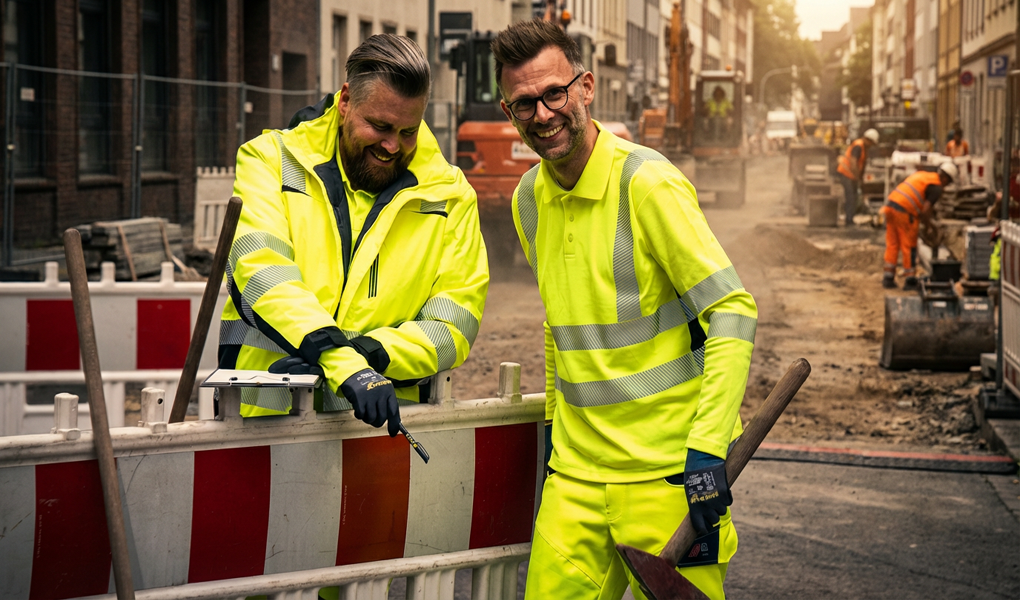
EN ISO 20471:2013 – Maximum visibility in high-risk situations
Imagine the following scenario: Monday morning – 6 a.m., you are preparing the construction site, it is still dark on the roads and traffic seems quiet. You are checking the position of the traffic cones when suddenly a car rushes past you, missing you by just a few centimetres. You were overlooked. This is exactly where a standard that can save lives comes into play: EN ISO 20471. It specifies the requirements that high-visibility clothing must meet when maximum visibility during the day, at dusk and at night is crucial.
Fluorescence and reflection: Why is the choice of material crucial?
To achieve optimum warning protection, a combination of two materials is used – a fluorescent base material and retro-reflective strips. The colour pigments contained in the material absorb high-energy UV light and re-emit it as light with a longer wavelength. In this way, invisible UV light is transformed into an intense, visible glow – particularly effective in daylight and at dusk. The additional strips reflect incident light back to the source, ensuring the necessary visibility even in poor lighting conditions.
How is the high-visibility class of PPE determined?
According to the EN ISO 20471 standard, there are three different high-visibility classes. As the high-visibility class increases, so do the minimum areas required for fluorescent background material and retro-reflective strips. The class of clothing is determined based on the smallest clothing size.
- Class 1: 0.14 m² HM / 0.10 m² RM
- Class 2: 0.50 m² HM / 0.13 m² RM
- Class 3: 0.80 m² HM / 0.20 m² RM
If high-visibility clothing is worn in combination, the protection class is also determined on the basis of a clothing combination (e.g. jacket and trousers). If the visible area of the combination meets the minimum requirements of a higher high-visibility class, both items can be classified in the higher class. This classification must be clearly indicated both in the manufacturer's specifications and on the label.
Application-dependent warning protection class
The required high-visibility class also depends on the specific conditions at the place of use – in particular, the permissible vehicle speed and lighting conditions. In public transport areas, visibility requirements are regulated as follows:
High-visibility clothing of class 2 is mandatory for vehicle speeds of up to 60 km/h. It provides sufficient visibility for activities in inner-city traffic or on side roads in daylight.
At speeds above 60 km/h or when working in the dark, at dusk or in conditions of poor visibility, Class 3 high-visibility clothing is required. This provides significantly higher visibility, even from a greater distance and in difficult visibility conditions, thanks to additional reflective zones on the torso and limbs.
What stresses are tested?
To ensure the quality and durability of materials, high-visibility clothing is tested under various conditions as part of standardised testing procedures. These include:
- Abrasion
- Permanent creasing
- Folding at low temperatures
- Temperature changes - influence of rain
- Washing
- Dry cleaning
The test results therefore guarantee that the protective functions will remain intact for a long time, even under heavy use.
What are the design requirements?
Design requirements for reflective strips are necessary to ensure the visibility of protective clothing from all angles. The width and angle of the reflective strips, as well as the distance between them, play a decisive role in this. The following summarises both the basic requirements and specific specifications for their placement on jackets, trousers, dungarees and overalls:
| Category | Technical specifications |
|---|---|
| Reflective strips |
|
| Jackets |
|
| Trousers & Dungarees |
|
| Overalls |
|
| Alternative arrangements |
|
EN 17353:2020 comparison – visibility at medium risk
This European standard defines requirements for high-visibility clothing for medium-risk situations. It differs significantly in that it is not intended for high-risk situations such as working on motorways and, even at the highest classification, offers less protection than the minimum requirements of class 3 of EN ISO 20471. In addition, there is a classification into types in which visibility is selectively increased depending on the conditions of use. The additional differentiation within type B allows for a graded categorisation of visibility in the dark, so that different safety levels can be met depending on the degree of risk.
Presentation of the different types:
| Type | Use & Material |
|---|---|
| Type A |
|
| Type B |
|
| Type AB |
|
| Subdivision (B / AB) | Details of reflective surface |
|---|---|
| Type B1 / AB1 |
|
| Type B2 / AB2 |
|
| Type B3 / AB3 |
|
Note: Type B is further subdivided into B1, B2 and B3. This subdivision also applies accordingly to type AB (as AB1, AB2 and AB3).
Visibility saves lives
Discover our high-visibility clothing certified according to EN 17353:2020 and EN ISO 20471 for maximum visibility in medium and high-risk environments.